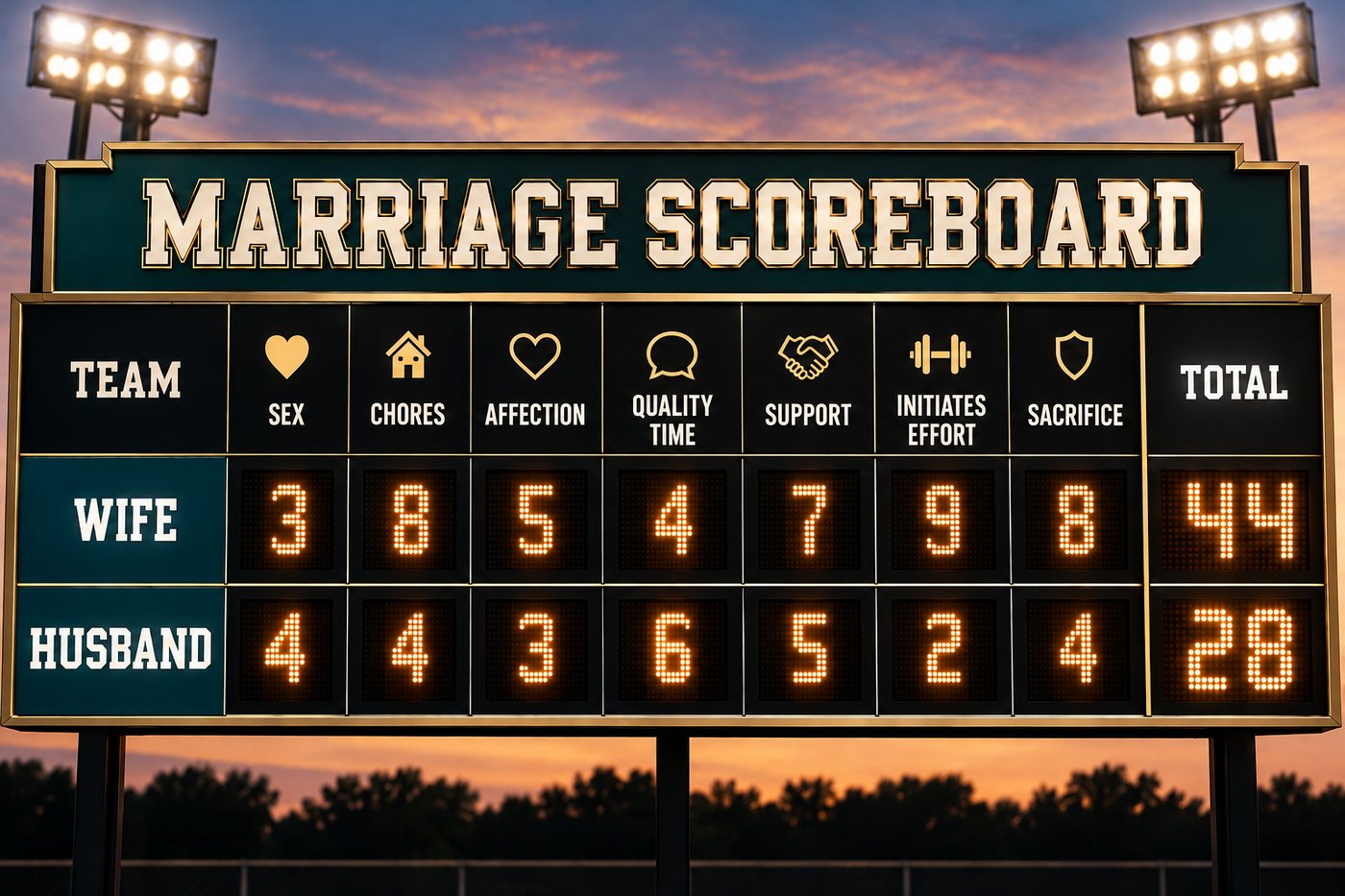
Do the following statements or internal dialogue sound familiar?
“ I initiated sex the last three times.”
“I'm always the one apologizing first.”
“I've been affectionate all week, and you still don't want to have sex!”
“I planned our last date night, did the laundry, and took care of the kids. What exactly have YOU done?”
Marriage can sometimes feel like an ongoing competition where both spouses are convinced they're losing!
We may not have an actual scoreboard hanging above our beds (although I can imagine some couples would love a giant electronic one!), but many of us are keeping an invisible tally of who's giving more, sacrificing more, initiating more, or receiving less.
When we begin measuring everything we give against everything we receive, intimacy can quietly become a transaction instead of a connection.
Most of us can admit that we have been guilty of doing this at least occasionally.
Why Do Couples Keep Score in Marriage?
I don't believe most couples begin marriage intending to compete against one another.
In fact, when we're first falling in love, we often delight in doing things for the other person. We eagerly look for opportunities to serve, surprise, encourage, and pursue them.
We don't usually think, “Well, I planned dinner tonight, so you owe me breakfast tomorrow!”
We simply enjoy giving.
But somewhere between careers, children, household responsibilities, disappointments, and the demands of everyday life, our generosity can become entangled with expectations.
Perhaps you've been carrying more of the household responsibilities. Maybe you've been the one initiating difficult conversations, planning time together, or attempting to maintain your sexual connection.
Over time, you begin noticing what you're doing and what your spouse isn't.
And slowly, the invisible scorecard appears.
Sometimes scorekeeping grows out of selfishness or entitlement. But other times, it's a wounded heart trying to communicate that something important is missing.
You may not actually be longing for your spouse to wash more dishes.
You may be longing to feel considered.
You may not simply want your spouse to initiate sex more often.
You may be longing to feel desired.
You may not be upset because you apologized first again.
You may be longing to know that your spouse values reconciliation as much as you do.
The scorecard often points toward a deeper emotional need that hasn't been expressed or addressed.
When Sexual Intimacy Becomes a Transaction
Let's talk about how this affects sex, because this is where scorekeeping can become especially destructive.
Consider some of these unspoken thoughts:
“I initiated last time. Now it's your turn.”
“You rejected me twice this week, so I'm not trying again.”
“I'm always the one focusing on your pleasure. What about mine?”
“I said yes when I wasn't in the mood. Why can't you do the same?”
“You haven't shown me affection all day, so don't expect sex tonight.”
“I do everything around here, and you can't even make time for intimacy?”
Can you recognize the frustration underneath some of these statements?
There may be genuine disappointment, loneliness, exhaustion, or sexual dissatisfaction.
Those feelings deserve attention.
However, when sexual intimacy becomes something we use to repay favors, settle debts, punish disappointments, or prove who's trying harder, we begin moving away from the very purpose of intimacy.
Sexual intimacy was designed to be an expression of mutual love, pleasure, vulnerability, and coventant union—not a reward system.
Being married doesn't mean your spouse owes you sexual access to their body.
At the same time, sexual concerns and differences in desire shouldn't simply be ignored.
Both spouses have an opportunity to approach their sexual relationship with care, curiosity, and a willingness to understand one another.
When someone feels pressured to participate sexually to balance the score, desire may become increasingly difficult to experience.
If this is a struggle in your marriage, I encourage you to read my article, Husbands, How to Turn on Your Wife, where I discuss emotional connection, sexual desire, and the things that can put the brakes on intimacy.
Or for wives, maybe you want to understand your husband better.... Try reading this article on understanding your husband: Wives, Pursue your Husband.
What's Really Hiding Under Your Scorecard?
I want you to consider something.
What if the scorecard isn't really about keeping things equal?
What if it's about wanting to know that you matter?
Think about the difference between these two statements:
“You never initiate sex anymore!”
And:
“I miss feeling desired by you. Sometimes I wonder if you're still attracted to me.”
Or consider:
“I'm always the one planning things for us!”
Compared with:
“I really miss feeling like you look forward to spending time with me.”
The first statements invite defensiveness.
The second statements invite understanding.
When we're busy presenting evidence of everything our spouse hasn't done, we can miss the opportunity to reveal what's actually happening inside our hearts.
And vulnerability is an essential ingredient of emotional intimacy.
Rather than continually asking, “Who's doing more?” perhaps we need to begin asking, “What am I really longing for, and have I communicated that lovingly and clearly?”
Of course, communicating vulnerably doesn't guarantee that your spouse will respond well. But it creates an opportunity for greater understanding instead of another round of accusations.
What Does God Say About Keeping Score?
One of the most beautiful descriptions of love appears in 1 Corinthians 13.
In verse 5, we're told that love “keeps no record of wrongs”.
That is a challenging statement when we consider how easily we remember our spouse's disappointments!
But I believe we need to understand this carefully.
God isn't telling us to ignore repeated betrayal, tolerate mistreatment, or pretend that destructive patterns don't exist.
Forgiveness and accountability can coexist.
There is a difference between keeping a record of wrongs to use as ammunition and recognizing patterns that genuinely need to change.
Love doesn't weaponize the past, but wisdom doesn't ignore it either.
Philippians 2:3–4 also challenges us to move away from selfish ambition and consider the interests of others.
Imagine what could happen if both spouses approached their marriage with this mindset.
Not, “How little can I give and still get what I want?”
But, “How can I genuinely love and care for the person God has entrusted to me?”
Notice that I said both spouses.
Biblical generosity is not an invitation for one person to endlessly give while the other refuses responsibility.
A thriving marriage involves two people growing in humility, love, faithfulness, and mutual consideration.
And the more we abide in Christ, the more we allow His love to shape the way we love one another.
Four Ways to Stop Keeping Score and Start Rebuilding Intimacy
1. Replace accusations with honest expressions of your needs.
Instead of presenting your spouse with a list of offenses, practice expressing what you feel and desire.
Rather than saying, “You never initiate sex,” try:
“I really enjoy feeling pursued by you, and I'd love for us to talk about how we can cultivate more mutual desire.”
This doesn't mean avoiding difficult conversations. It means approaching them with the intention of understanding rather than winning.
2. Practice appreciation without turning it into another tally.
When was the last time you thanked your spouse for something they regularly do?
It's easy to notice what's missing while overlooking what's consistently being given.
Look for opportunities to express genuine gratitude.
But don't make appreciation another strategy to get something in return!
Generosity loses its beauty when it becomes a disguised invoice. Expressing gratitude goes a long way!
3. Be intentional about nurturing intimacy.
Don't assume that a fulfilling emotional and sexual relationship will simply happen when everything else is finished.
For many couples, everything else is never finished!
Talk about your desires, plan meaningful time together, enjoy affectionate touch without expectations, and look for ways to delight in one another.
4. Address genuine imbalances rather than silently collecting evidence.
This is especially important. Putting down your scorecard doesn't mean you should stop recognizing when something is genuinely unfair.
Perhaps one spouse is consistently carrying the emotional labor, household responsibilities, or efforts toward sexual connection. These patterns deserve honest discussion.
Sometimes couples need to redistribute responsibilities, establish healthier expectations, seek professional support, or work through deeper wounds.
The goal isn't to stop noticing problems. It's to stop using those problems as weapons against each other.
You can pursue generosity while still communicating boundaries, needs, and expectations.
A Challenge for Your Marriage This Week
Here's something I'd love for you to try.
First, ask yourself:
“Where have I been keeping score in my marriage?”
Maybe it's household responsibilities, affection, sexual initiation, apologies, or sacrifices.
Then ask a deeper question:
“What am I hoping my spouse will recognize about me through this scorecard?”
Perhaps you want to feel appreciated, desired, respected, supported, or emotionally safe.
Finally, consider sharing that deeper longing with your spouse. And invite them to share theirs. Instead of comparing who has done more, spend some time genuinely listening to one another. You might discover that beneath two competing scorecards are two people who simply want to feel loved.
Marriage Was Never Meant to Have a Winner and a Loser
When marriage becomes a competition, even the person who wins the argument can lose the connection.
God designed marriage to reflect something much more beautiful than a running tally of contributions and disappointments.
It's an invitation into a covenant relationship where love is practiced through generosity, truth, grace, accountability, and mutual delight.
Intimacy cannot flourish when two people are more committed to proving what they've given than understanding what the other needs.
If you and your spouse are struggling with resentment, differences in sexual desire, or emotional disconnection, I'd love to help you cultivate a healthier, more fulfilling relationship.
Explore Abiding Love Intimacy Coaching and book your free discovery call.
Love,
Kristi Claudel
Certified Sexologist, Intimacy CoachAbiding Love Intimacy Coaching, LLC